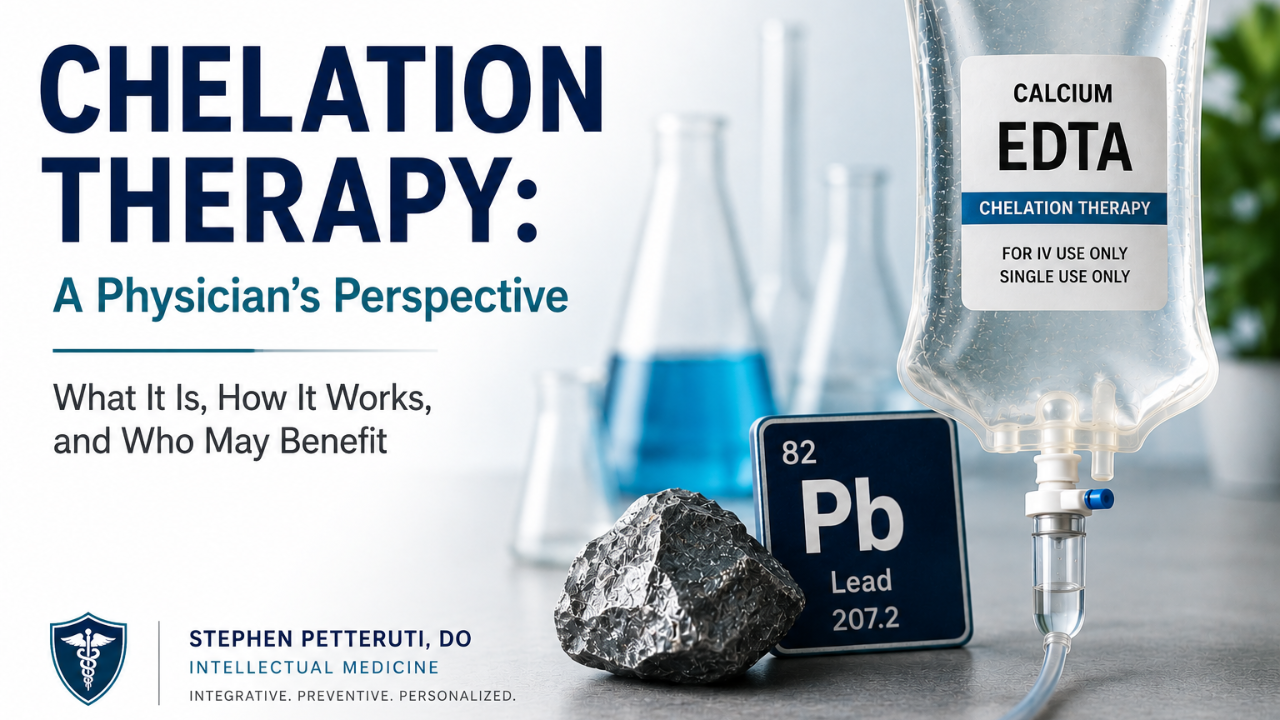
Chelation Therapy: What It Is, How It Works, and Who May Benefit
Jul 23, 2026A physician’s perspective on how chelation therapy removes certain metals, when it is medically appropriate, and what patients should know about its benefits, risks, and monitoring.
By Stephen Petteruti, DO
Board-Certified Family Physician | Founder, Intellectual Medicine | Last reviewed July 2026
For decades, preventive medicine has focused on managing the traditional risk factors for chronic disease. We measure cholesterol, monitor blood pressure, control blood sugar, encourage exercise, and promote healthy nutrition. These interventions have unquestionably improved health and saved countless lives.
However, a growing number of individuals are raising an alternative question:
What about the substances that accumulate in our bodies over a lifetime but are not routinely measured?
Every day we are exposed to substances in our environment that previous generations encountered far less frequently. Air pollution, industrial emissions, contaminated soil, aging water infrastructure, certain imported products, and decades of environmental contamination have all contributed to an increased awareness of toxic exposures. While our bodies are remarkably capable of eliminating many of these substances, others—particularly certain heavy metals—can accumulate over time.
Lead is perhaps the best example.
Although severe lead poisoning is far less common than it once was, chronic low-level exposure remains a public health concern. Unlike many chemicals that are metabolized and eliminated relatively quickly, lead can be stored in bone and soft tissues for decades. Research has associated long-term lead accumulation with hypertension, cardiovascular disease, cognitive decline, kidney disease, and increased all-cause mortality. In fact, some experts now believe there may be no completely safe level of lead exposure, making lifetime accumulation an important consideration in preventive health.
As awareness of environmental toxins has grown, so has interest in therapies designed to reduce the body's burden of accumulated heavy metals. One treatment that frequently enters this conversation is chelation therapy.
Individuals researching chelation therapy online often encounter two markedly different narratives.
Some sources characterize chelation therapy as a breakthrough treatment capable of reversing chronic disease, whereas others dismiss it as unnecessary or lacking scientific support. As with many topics in medicine, the reality is considerably more nuanced than either extreme.
Chelation therapy is neither a miracle cure nor a treatment that should be dismissed without thoughtful consideration. It is a well-established medical therapy with decades of clinical use for specific conditions, particularly documented heavy metal poisoning. At the same time, researchers continue to investigate whether carefully selected patients with chronic, low-level heavy metal accumulation may also benefit from treatment. That distinction is important because the evidence supporting these different uses is not the same.
Throughout my career in preventive medicine, I have believed that medical decisions should be guided by science rather than marketing, fear, or ideology. Over the years, I have incorporated calcium EDTA chelation therapy into my practice for appropriately selected patients while also conducting research to better understand its effects. In 2020, my colleagues and I published a prospective study in Cureus demonstrating that intermittent calcium EDTA infusions significantly reduced accumulated body lead levels in healthy adults without evidence of kidney injury or significant treatment-related adverse events. More recently, our research has expanded into examining the relationship between calcium EDTA therapy and cardiovascular health, further exploring questions that deserve scientific investigation.
My goal has never been to convince every patient that chelation therapy is necessary. In fact, I believe many people are not appropriate candidates for treatment. Instead, my objective is to provide patients with clear, evidence-based information so they can understand what chelation therapy is, how it works, what the published research actually shows, and where its potential role may fit within a comprehensive preventive medicine strategy.
In this article, I will explore the science underlying heavy metal accumulation, explain the mechanisms of calcium EDTA chelation therapy, review my published research alongside other significant studies, discuss patient selection criteria, and distinguish evidence from misinformation. Whether readers are curious about chelation therapy or considering its relevance to their own health, my aim is to provide a balanced understanding grounded in scientific evidence and clinical experience.
The Importance of Heavy Metals in Environmental Health
Heavy metals have existed in the natural environment since the formation of the Earth. Elements such as lead, mercury, arsenic, and cadmium are naturally present in the Earth's crust and have historically been found only in trace amounts. In recent centuries, the most significant change has been the increased extent of human exposure to these elements.
Industrialization has markedly increased environmental concentrations of heavy metals. Sources include aging water infrastructure, industrial emissions, mining, manufacturing, lead-based paints, contaminated soil, imported consumer products, and various occupational or recreational activities. While regulatory interventions have reduced many exposures, they have not been fully eradicated. As a result, most individuals now carry some degree of heavy metal accumulation due to modern environmental conditions.
Lead is among the most extensively studied heavy metals with respect to human exposure.
In contrast to many substances that the body can metabolize and eliminate efficiently, lead has no beneficial biological function. Upon entering the body, a fraction of lead circulates in the bloodstream, while the majority is deposited in bones and other tissues, where it can persist for decades. Approximately 90 to 95 percent of the total lead burden in adults is stored in bone, gradually exchanging with the bloodstream over the lifespan.
This distinction helps explain why chronic lead exposure differs significantly from acute lead poisoning.
The term "lead poisoning" often evokes images of children ingesting paint chips or industrial workers experiencing severe toxic exposure. Although such cases do occur, they represent only the most extreme scenarios. Currently, a greater concern is the gradual accumulation of small amounts of lead over extended periods. Individuals may never exhibit symptoms of acute toxicity yet still possess a substantial lifetime burden of stored lead.
Researchers have shown increasing interest in chronic low-level lead exposure due to its association with a broad spectrum of long-term health conditions. Numerous studies have linked elevated lead burden to hypertension, cardiovascular disease, chronic kidney disease, cognitive decline, peripheral vascular disease, and increased risk of premature mortality. Although these studies primarily demonstrate associations rather than direct causation, they have influenced contemporary perspectives in environmental toxicology and preventive medicine.
Recent research suggests that there may be no entirely safe threshold for lead exposure. Despite declining blood lead levels in the population over recent decades, adverse health effects have been observed even at concentrations previously deemed acceptable. As a result, many experts now prioritize minimizing unnecessary lifetime exposure rather than attempting to define a specific "safe" level.
It is also essential to recognize that lead represents only one component of a broader issue. Individuals are exposed to a complex mixture of environmental toxins throughout their lives. While each individual exposure may be minor, the cumulative effect over decades is an ongoing subject of scientific investigation. Preventive medicine increasingly focuses not only on treating disease after onset but also on reducing the multitude of factors that may contribute to disease development long before symptoms manifest.
This perspective has informed my professional work. I maintain that effective prevention requires consideration beyond traditional laboratory values, encompassing broader questions of long-term health. Although heavy metals are not the only contributors to cardiovascular disease, cognitive decline, or aging, they constitute a significant factor that merits careful evaluation. Prior to discussing the potential role of chelation therapy in reducing accumulated heavy metals, it is necessary to examine how these metals enter the body, their persistence, and the current scientific evidence regarding their health impacts.
How Do Heavy Metals Enter the Body?
Patients frequently inquire, "How might I have been exposed to heavy metals?"
Many individuals assume that heavy metal exposure is limited to those working in factories, mines, or hazardous industrial environments. Although occupational exposure remains a significant source of toxic metal accumulation, it is not the only one. In reality, most people encounter small amounts of heavy metals throughout their lives as a consequence of living in the modern world.
Lead serves as a prominent example.
Despite the removal of lead from gasoline, residential paint, and many consumer products, it persists in the environment. Older homes may still contain lead-based paint or plumbing components. Aging municipal water systems can contribute to lead contamination, especially when older service lines are disturbed. Soil near highways, industrial facilities, and older neighborhoods may retain elevated lead concentrations from decades of deposition. Imported pottery, ceramics, spices, cosmetics, toys, and certain herbal remedies have also been identified as potential sources of lead exposure.
Occupational or recreational activities may contribute to additional lead exposure. Construction workers, welders, battery manufacturers, painters, mechanics, law enforcement personnel who frequent indoor firing ranges, competitive shooters, and individuals involved in metal recycling may encounter higher lead levels than the general population. Activities such as making stained glass, casting fishing weights, or reloading ammunition can also increase exposure if proper precautions are not observed.
Other heavy metals also warrant consideration.
Mercury exposure can result from consumption of certain fish species, industrial processes, or older dental amalgams. Cadmium exposure is associated with cigarette smoke, industrial emissions, batteries, and some fertilizers. Arsenic occurs naturally in groundwater in specific regions and may also be present in certain foods, particularly rice and seafood. Each metal exhibits distinct biological behavior, yet all have been extensively studied for their potential long-term health effects.
The human body possesses complex systems for eliminating many environmental toxins. The liver, kidneys, gastrointestinal tract, lungs, and skin all contribute to detoxification and excretion. However, certain heavy metals differ from other environmental chemicals. Instead of being rapidly metabolized and eliminated, they may accumulate in tissues over extended periods.
Lead is especially notable in this context. After entering the body via inhalation or ingestion, lead initially circulates in the bloodstream. Over time, most lead becomes incorporated into bone, where it can persist for decades. Bone acts as a long-term reservoir, gradually releasing small amounts of lead back into the bloodstream throughout life. Consequently, an individual may no longer have active environmental exposure but still retain a significant body burden from exposures that occurred many years or even decades earlier.
This concept illustrates why evaluating heavy metal exposure is often more complex than commonly assumed. A normal blood lead level does not necessarily indicate the absence of accumulated lead in the body. Blood testing primarily reflects recent or ongoing exposure, while most lead is stored in other tissues. Researchers continue to investigate optimal methods for estimating long-term body burden, and each testing approach has distinct strengths and limitations.
Heavy metal exposure represents only one of many factors that may influence long-term health. It is not the sole cause of heart disease, cognitive decline, hypertension, or chronic illness. Genetics, nutrition, physical activity, sleep, metabolic health, smoking, alcohol use, and various other environmental factors all contribute to overall health outcomes. Preventive medicine rarely involves identifying a single cause; rather, it emphasizes recognizing and addressing the multiple factors that, over a lifetime, may increase or decrease an individual's risk of disease.
Understanding the entry and behavior of heavy metals in the body provides essential context for discussing chelation therapy. Before determining whether treatment is appropriate, patients should first understand what chelation entails, how it functions, and what scientific evidence demonstrates regarding its potential role in reducing accumulated heavy metals.
What Is Chelation Therapy?
Chelation therapy is a medical treatment that uses specialized compounds to bind certain metals in the body so they can be safely eliminated, primarily through the kidneys. The process has been used in medicine for more than 70 years and remains the standard treatment for several forms of documented heavy metal poisoning.
The term chelation is derived from the Greek word chele, meaning "claw." This terminology reflects the mechanism by which chelating agents surround and bind metal ions, forming stable complexes that can be excreted in the urine.
Not all metals behave the same way, and not all chelating agents bind the same metals. Different medications have different affinities depending on the type of metal being treated. Selecting the appropriate chelating agent requires an understanding of the patient's history, laboratory findings, kidney function, and the specific metal involved.
One of the most widely studied and commonly used chelating agents is calcium EDTA, or calcium disodium ethylenediaminetetraacetic acid. Calcium EDTA has been approved for decades as a treatment for lead poisoning and has an extensive history of clinical use. In carefully selected patients, some physicians also use calcium EDTA to reduce accumulated lead burden in individuals who do not meet the criteria for acute lead poisoning but who have evidence of chronic heavy metal accumulation. This preventive application continues to be investigated and should not be confused with its established role in treating documented heavy metal toxicity.
Chelation therapy should not be considered a universal detoxification method. It does not cleanse the liver, flush the colon, or remove unspecified toxins as sometimes claimed in wellness marketing. Chelating agents are chemically engineered to bind specific metals rather than all substances present in the body. Assertions that chelation therapy eliminates all toxins or treats a broad spectrum of unrelated diseases lack support from current scientific evidence.
When calcium EDTA is administered intravenously, it circulates through the bloodstream and binds to metals for which it has a strong chemical affinity, particularly lead. Once these metal-EDTA complexes are formed, they become water-soluble and are filtered by the kidneys, allowing them to be excreted in the urine. This process reduces the amount of circulating metal available to be redistributed throughout the body.
Because the kidneys play a central role in eliminating these complexes, kidney function must be carefully evaluated before treatment begins. Patients receiving chelation therapy should also be appropriately monitored throughout their treatment course to ensure the therapy remains both safe and effective.
While the fundamental chemistry underlying chelation is well understood, determining appropriate candidates for treatment is considerably more complex. The ability of a medication to remove metals does not imply universal benefit for all patients. Decisions regarding chelation therapy should be grounded in a comprehensive evaluation of exposure history, laboratory data, overall health status, and specific therapeutic objectives.
This distinction informs the ongoing debate regarding chelation therapy. The medical community generally agrees on its role in treating confirmed heavy metal poisoning. However, uncertainty persists about whether reducing chronic, low-level heavy metal accumulation improves long-term health outcomes in selected patients. Ongoing research, including my own published studies, continues to address these unresolved questions.
Before examining the research, it is essential to understand the physiological processes that occur following heavy metal absorption, particularly the mechanisms by which lead persists in human tissues for decades. This physiological context underpins the rationale for considering chelation therapy in certain patients.
How Lead Is Stored in the Body (And Why It Can Remain for Decades)
A common misconception regarding lead exposure is the belief that lead is rapidly eliminated from the body once exposure ceases. Although this may apply to certain environmental chemicals, it does not hold true for lead.
Lead is unique because the body has no biological use for it, yet it cannot efficiently eliminate all of it once it has been absorbed. Instead, lead is gradually redistributed throughout the body and stored in various tissues, creating what researchers refer to as the body burden of lead.
After lead enters the body, either through inhalation or ingestion, it is initially transported in the bloodstream. During this early phase, a portion of the lead is filtered and excreted by the kidneys. The remainder, however, is distributed into soft tissues such as the liver, kidneys, and brain before eventually becoming incorporated into the skeleton.
In adults, approximately 90 to 95 percent of the body's total lead burden is stored in bone. Because lead has chemical properties similar to calcium, the body deposits it into bone tissue where it can remain for decades. Rather than being permanently locked away, this stored lead exists in a dynamic equilibrium, slowly moving between bone and the bloodstream throughout life.
This is why lead exposure should not be viewed as a single event but as a cumulative process. Each exposure may contribute only minimally to the total body burden. However, over several decades, these incremental exposures can result in significant accumulation.
Why Stored Lead Still Matters
There is a common assumption that lead stored in bone is inert and harmless. However, this is not always accurate. Bone is not an inactive tissue. It is constantly being broken down and rebuilt through a natural process known as bone remodeling. As bone is remodeled, small amounts of stored lead can be released back into the bloodstream, even if no new environmental exposure is occurring.
Several situations can accelerate this process, including:
- Aging
- Osteoporosis
- Menopause
- Pregnancy and breastfeeding
- Significant weight loss
- Bone fractures
- Certain medical conditions that increase bone turnover
Consequently, individuals exposed to lead many years prior may continue to experience internal exposure long after the initial source has been eliminated.
Blood Lead Levels Tell Only Part of the Story
When patients are concerned about heavy metal exposure, one of the first questions they ask is whether a blood test can determine if they have accumulated lead.
A standard blood lead test is excellent for identifying recent or ongoing exposure. If someone has recently encountered lead in their workplace, drinking water, or another environmental source, blood testing is often the appropriate diagnostic tool.
However, blood lead concentration reflects only a small proportion of the total body lead burden at any given time. Since most lead is sequestered in bone rather than circulating in the bloodstream, a normal blood lead level does not necessarily indicate minimal overall accumulation.
This distinction has emerged as a significant focus in environmental medicine research. Investigators are actively seeking improved methods for estimating long-term body burden, acknowledging that chronic accumulation is not always adequately assessed by blood testing alone.
Certain clinicians employ provocative urinary heavy metal testing following administration of a chelating agent to estimate mobilizable body stores. This method remains controversial, with ongoing debate concerning its interpretation and clinical relevance. As with any laboratory assessment, results should be integrated with the patient's exposure history, clinical symptoms, physical examination, and overall clinical context rather than interpreted in isolation.
Why Cumulative Exposure Is the Greater Concern
Today, severe lead poisoning is relatively uncommon in the United States compared with previous generations. Public health efforts have dramatically reduced exposure through the removal of leaded gasoline, restrictions on lead-based paint, improvements in workplace safety, and tighter environmental regulations.
For many adults, the primary concern is not acute toxicity but the potential for significant lifetime accumulation resulting from decades of low-level exposures.
Research increasingly demonstrates that chronic, low-level lead exposure is associated with numerous long-term health conditions, such as hypertension, cardiovascular disease, chronic kidney disease, cognitive decline, and increased all-cause mortality. Although these studies establish associations rather than direct causation, they have significantly influenced medical perspectives on environmental toxins and preventive healthcare.
Rather than asking whether someone has experienced severe lead poisoning, many researchers are now asking a different question:
Could reducing unnecessary lifetime exposure—and potentially lowering accumulated body burden—help improve long-term health?
This question remains a subject of active scientific investigation and contributes to the growing interest in chelation therapy. Before presenting findings from my own published research, it is useful to review the mechanism of action of calcium EDTA and its prominence as a widely studied chelating agent in clinical practice.
Why Calcium EDTA?
Although the term chelation therapy is often used broadly, it actually refers to a group of medications that bind specific metals so they can be safely eliminated from the body. Different chelating agents have different chemical properties, making them more effective for certain metals than others. Selecting the appropriate treatment depends on the type of metal involved, the patient's overall health, kidney function, and the clinical situation.
One of the most widely studied chelating agents is calcium disodium ethylenediaminetetraacetic acid, more commonly known as calcium EDTA.
Calcium EDTA has been used in medicine for decades and is an FDA-approved treatment for documented lead poisoning. Its role in treating acute lead toxicity is well established and supported by years of clinical experience. More recently, researchers have explored whether calcium EDTA may also help reduce chronic accumulated lead burden in carefully selected patients who do not have acute lead poisoning but have evidence of significant lifetime exposure.
To understand why calcium EDTA has attracted so much attention, it helps to understand how it works.
How Calcium EDTA Works
Calcium EDTA is a synthetic amino acid with a unique ability to bind positively charged metal ions. When administered intravenously, it circulates through the bloodstream and acts like a molecular "claw," seeking out metals for which it has a strong chemical affinity, particularly lead.
As the EDTA molecule encounters lead, it forms a stable complex with the metal. Once bound, the lead-EDTA complex becomes water-soluble and can be filtered by the kidneys and excreted in the urine. In this way, calcium EDTA helps the body eliminate lead that has entered the circulation.
This process differs substantially from the popular concept of a "detox."
Chelation therapy does not indiscriminately remove toxins from the body or cleanse the liver. It is a targeted medical treatment based on well-understood principles of chemistry. The goal is to bind specific metals so they can be eliminated more efficiently than the body could accomplish on its own.
Why Calcium EDTA Contains Calcium
A common question from patients concerns why calcium is included in the medication when the primary objective is to remove metals. The answer lies in safety.
EDTA exhibits a strong affinity for various positively charged minerals. If administered alone, EDTA could bind endogenous calcium in the bloodstream, which may result in dangerously low calcium levels. Administering EDTA pre-bound to calcium significantly mitigates this risk. In this formulation, calcium acts as a placeholder, exchanged only when EDTA encounters metals with a higher chemical affinity, such as lead.
This approach renders calcium EDTA substantially safer than administering EDTA alone and is a primary reason it has become the preferred formulation for treating lead toxicity.
A Treatment That Requires Medical Supervision
While the underlying chemistry of calcium EDTA is straightforward, determining appropriate candidates for treatment is considerably more complex. Chelation therapy is not appropriate for everyone.
Prior to initiating treatment, physicians should conduct a thorough review of the patient's medical history, potential sources of heavy metal exposure, laboratory data, renal function, current medications, and overall health status. Since the kidneys are responsible for eliminating metal-EDTA complexes, monitoring renal function before and throughout treatment is essential for safe clinical practice.
Equally important, chelation therapy should not be considered a substitute for reducing ongoing exposure. Identifying and eliminating the source of heavy metal exposure must remain the primary priority whenever feasible. Chelation addresses accumulated body burden; it does not prevent future exposure.
Why I Became Interested in Studying Calcium EDTA
Throughout my career, I have been interested in identifying modifiable factors that may influence long-term health before disease develops.
As I incorporated calcium EDTA into carefully selected patients, I found that much of the published literature focused on treating acute lead poisoning or evaluating cardiovascular outcomes. Surprisingly little prospective research had examined whether intermittent calcium EDTA therapy could meaningfully reduce accumulated lead burden in otherwise healthy adults with no known occupational lead exposure.
Instead of relying solely on theoretical considerations or anecdotal experience, I sought objective data.
This question ultimately prompted my colleagues and me to design and publish a prospective clinical study evaluating the effects of intermittent calcium EDTA therapy on accumulated body lead levels. The results offered important insights into both the capabilities and limitations of this therapy.
In the following section, I will review that study, explain the rationale for its design, and discuss the implications of its findings for our understanding of chelation therapy.
My Published Research on Calcium EDTA Chelation Therapy
As physicians, we often rely on published research to guide clinical decisions. However, there are times when important questions have not been adequately studied. Throughout my years in preventive medicine, I found myself asking one of those questions.
We know calcium EDTA is effective for treating documented lead poisoning. We also know that most adults have experienced some degree of lifetime lead exposure, even if they have never worked in a high-risk occupation or developed symptoms of acute toxicity. What was less clear was whether intermittent calcium EDTA therapy could meaningfully reduce accumulated body lead in otherwise healthy adults while maintaining a favorable safety profile.
That question led my colleagues and me to conduct a prospective clinical study, which was later published in the peer-reviewed journal Cureus. Our goal was straightforward: determine whether a practical outpatient calcium EDTA protocol could reduce accumulated lead burden in healthy adults and evaluate whether treatment could be administered safely over time.
Study Design
The study enrolled 15 healthy adult volunteers with no known occupational lead exposure. None of the participants had a history of acute lead poisoning, making the study more representative of the type of patient commonly encountered in preventive medicine practices.
Before beginning treatment, each participant underwent provocative urinary heavy metal testing to establish a baseline estimate of mobilizable lead stores. Participants then received a series of intermittent intravenous calcium EDTA infusions administered over approximately two years.
Following completion of treatment, provocative urine testing was repeated to evaluate changes in lead excretion and estimate the effect of therapy on accumulated body burden.
In addition to measuring lead levels, we closely monitored kidney function and assessed participants for any treatment-related adverse events throughout the study. As calcium EDTA is eliminated via the kidneys, establishing safety was as critical as demonstrating efficacy.
What We Found
The results were encouraging.
On average, participants received 14 calcium EDTA infusions over approximately 24 months.
After completing treatment:
- Average provoked urinary lead levels decreased by approximately 39 percent.
- Every participant demonstrated a measurable reduction in lead levels.
- No participant experienced a treatment-related adverse event.
- Kidney function remained stable throughout the study.
These findings indicated that intermittent calcium EDTA therapy was associated with a significant reduction in measured lead burden while maintaining an excellent safety profile in this carefully selected cohort of healthy adults.
One of the most notable observations was the consistency of the results. Although the magnitude of reduction varied among participants, every individual demonstrated improvement following treatment. This consistency suggests that the protocol reliably reduced mobilizable lead stores under the study conditions.
What the Study Does and Does Not Prove
While these findings are significant, they require interpretation.
Our study demonstrated that intermittent calcium EDTA therapy reduced measured lead burden in healthy adults. It also demonstrated that the treatment protocol was well tolerated in the patients we studied.
What the study did not demonstrate is equally important.
It did not prove that lowering accumulated lead prevents heart disease, reduces the risk of dementia, improves longevity, or eliminates the risk of chronic illness. Those are much larger clinical questions that require randomized controlled trials with long-term follow-up.
Before asking whether lowering lead improves health outcomes, researchers must first establish that lead can be safely and meaningfully reduced. Our study addressed that foundational question.
The next question; whether reducing accumulated lead translates into measurable improvements in long-term health, remains an active area of research and deserves continued scientific investigation.
Why This Research Matters
Preventive medicine is founded on the principle of identifying risk factors prior to the onset of disease. We routinely encourage patients to lower elevated cholesterol, improve blood pressure, control blood sugar, stop smoking, and maintain a healthy weight because decades of research have shown these changes reduce future health risks.
Environmental exposures warrant the same level of thoughtful consideration.
If chronic lead accumulation contributes to long-term disease, as an increasing body of evidence suggests, then finding safe and effective ways to reduce unnecessary lead burden becomes an important area of preventive medicine. While much remains to be learned, our published research adds to the growing body of evidence demonstrating that calcium EDTA can meaningfully reduce accumulated lead in appropriately selected patients.
Determining the implications for long-term health will require further research. However, meaningful scientific advances begin by addressing questions that can be measured today.
Final Thoughts: Prevention Is About Reducing Risk, Not Chasing Certainty
A common misconception in medicine is that every health decision has a straightforward right or wrong answer. In practice, preventive medicine often involves managing probabilities rather than certainties.
Chelation therapy is a good example.
Calcium EDTA has a well-established role in treating documented lead poisoning, with decades of clinical use supporting its safety when administered appropriately. Concurrently, researchers are investigating whether reducing chronic, accumulated lead burden may influence long-term health outcomes in carefully selected individuals. Although the evidence continues to evolve, it is clear that environmental exposures warrant thoughtful consideration within a comprehensive health strategy.
My published research demonstrated that intermittent calcium EDTA therapy can significantly reduce measured body lead burden in healthy adults without adversely affecting kidney function. This finding addresses a key question regarding the therapy's capacity to reduce accumulated lead. However, it does not resolve broader questions about the impact of lead reduction on future cardiovascular disease, cognitive decline, or longevity. These larger questions require further investigation.
Medicine advances by building evidence one study at a time.
As physicians, our responsibility is to remain inquisitive, critically evaluate emerging research, and communicate transparently about both established knowledge and areas of uncertainty. Patients deserve this same level of honesty. They should receive recommendations grounded in evidence rather than marketing, and they should be informed of both the potential benefits and limitations of any treatment before making decisions.
That philosophy has guided my approach throughout my career.
I do not believe chelation therapy is a cure-all, nor do I believe every patient should pursue it. Heavy metal accumulation is just one of many factors that influence long-term health. Nutrition, exercise, sleep, metabolic health, stress management, smoking cessation, and blood pressure control all play critical roles in preventing chronic disease. No single therapy can replace these fundamental pillars of health.
Nonetheless, I maintain that environmental toxins should not be disregarded solely due to measurement challenges or incomplete knowledge. Prevention involves identifying modifiable risk factors wherever they exist and making informed decisions to reduce cumulative bodily burden over time.
For individuals concerned about heavy metal exposure, the initial step should not be scheduling chelation therapy. Instead, it is essential to understand individual risk. A comprehensive review of medical history, occupational and environmental exposures, laboratory findings, and overall health can help determine whether further evaluation is warranted. For many, treatment may not be necessary; for others, it may serve as one component of a broader preventive health strategy.
The goal should never be to chase the latest trend or seek a miracle treatment.
The objective is to make informed, evidence-based decisions that promote long-term health.
Frequently Asked Questions
Is chelation therapy FDA-approved?
Yes. Calcium EDTA is FDA-approved for the treatment of documented lead poisoning. Its use as part of a preventive strategy for chronic, low-level lead accumulation is considered an area of ongoing clinical investigation and should only be considered after careful medical evaluation.
Is chelation therapy safe?
When performed under the supervision of a qualified healthcare provider, calcium EDTA has a well-established safety profile. Before treatment, kidney function and overall health should be evaluated, and patients should be monitored throughout therapy.
Does chelation therapy remove all toxins?
No. Chelation therapy is designed to bind specific metals. It is not a general detoxification treatment and should not be viewed as a way to eliminate all environmental toxins from the body.
Should everyone be tested for heavy metals?
Not necessarily. Testing should be guided by an individual's medical history, occupational or environmental exposures, symptoms, and clinical judgment. Routine testing for every patient is not appropriate.
Does chelation therapy prevent heart disease or dementia?
Current evidence does not support making that claim. While chronic lead exposure has been associated with cardiovascular disease, cognitive decline, and other chronic conditions, more research is needed to determine whether reducing accumulated lead directly lowers the risk of developing these diseases.
Learn More
Understanding whether chelation therapy is appropriate begins with understanding you. Every patient has a unique medical history, environmental exposures, and health goals. If you'd like a personalized assessment, schedule a consultation with Dr. Stephen Petteruti. Together, you'll review your health history, evaluate potential heavy metal exposures, discuss appropriate testing when indicated, and determine whether chelation therapy or another preventive strategy is the right approach for your long-term health.
Related Published Research by Dr. Stephen Petteruti
- Petteruti S. Reduction of Lead Levels in Patients Following a Long-Term, Intermittent Calcium EDTA-Based Intravenous Chelation Infusions: A Prospective Experimental Cohort. Cureus. 2020;12(11):e11685.
- Petteruti SJ, Frazzini V. Reduction of Calcium Scores Using Intravenous Chelation: A Retrospective Pilot Study. Cureus. 2023;15(9):e44657.
References
- Menke A, Muntner P, Batuman V, Silbergeld EK, Guallar E. Blood lead below 0.48 μmol/L (10 μg/dL) and mortality among US adults. Circulation. 2006;114(13):1388-1394. doi:10.1161/CIRCULATIONAHA.106.628321.
- Lanphear BP, Rauch S, Auinger P, Allen RW, Hornung RW. Low-level lead exposure and mortality in US adults: a population-based cohort study. Lancet Public Health. 2018;3(4):e177-e184. doi:10.1016/S2468-2667(18)30025-2.
- Patterson CC, Shirahata H, Ericson JE. Lead in ancient human bones and its relevance to historical developments of social problems with lead. Sci Total Environ. 1987;61:167-200. doi:10.1016/0048-9697(87)90366-4.
- Moreno RC, Navas-Acien A, Escolar E, et al. Potential roles of metal chelation to prevent cardiovascular complications of diabetes. J Clin Endocrinol Metab. 2019;104(7):2931-2941. doi:10.1210/jc.2018-01484.
- Aneni EC, Escolar E, Lamas GA. Chronic toxic metal exposure and cardiovascular disease: mechanisms of risk and emerging role of chelation therapy. Curr Atheroscler Rep. 2016;18(12):81. doi:10.1007/s11883-016-0631-0.
- Lamas GA, Navas-Acien A, Mark DB, Lee KL. Heavy metals, cardiovascular disease, and the unexpected benefits of chelation therapy. J Am Coll Cardiol. 2016;67(20):2411-2418. doi:10.1016/j.jacc.2016.02.066.
- Born T, Kontoghiorghe CN, Spyrou A, Kolnagou A, Kontoghiorghes GJ. EDTA chelation reappraisal following new clinical trials and regular use in millions of patients: review of preliminary findings and risk/benefit assessment. Toxicol Mech Methods. 2013;23(1):11-17. doi:10.3109/15376516.2012.730562.
- Alam ZH, Ujueta F, Arenas IA, Nigra AE, Navas-Acien A, Lamas GA. Urinary metal levels after repeated edetate disodium infusions: preliminary findings. Int J Environ Res Public Health. 2020;17(13):4684. doi:10.3390/ijerph17134684.
- Agency for Toxic Substances and Disease Registry. Toxicological Profile for Lead. U.S. Department of Health and Human Services; 2020.
- Centers for Disease Control and Prevention. Blood Lead Reference Value. Updated October 24, 2024. https://www.cdc.gov/lead-prevention/php/data/blood-lead-reference-value/index.html
- World Health Organization. Lead Poisoning and Health. Updated August 11, 2023. https://www.who.int/news-room/fact-sheets/detail/lead-poisoning-and-health
- U.S. Environmental Protection Agency. Basic Information About Lead in Drinking Water. Updated January 8, 2025. https://www.epa.gov/ground-water-and-drinking-water/basic-information-about-lead-drinking-water
About the Author
Dr. Stephen Petteruti, DO is a board-certified physician and the founder of Intellectual Medicine, a preventive and functional medicine practice based in Fort Lauderdale, Florida. With more than three decades of clinical experience, he focuses on helping patients reduce their risk of chronic disease through evidence-based lifestyle interventions, hormone optimization, environmental medicine, and personalized preventive care.
Dr. Petteruti is the author of peer-reviewed research on calcium EDTA chelation therapy, including a prospective clinical study demonstrating reductions in accumulated body lead following intermittent intravenous calcium EDTA treatment. His work has also examined the potential relationship between EDTA chelation therapy and coronary artery calcium scores, reflecting his ongoing interest in identifying modifiable factors that influence long-term cardiovascular health.
As the founder of Intellectual Medicine University, Dr. Petteruti also educates healthcare professionals on preventive and functional medicine through clinical training programs grounded in scientific evidence and real-world patient care. He is the author of Fight Cancer Like a Man, a best-selling book that encourages men to make thoughtful, informed decisions about prostate cancer diagnosis and treatment.
Through his clinical practice, research, writing, and educational programs, Dr. Petteruti remains committed to one guiding principle: empowering patients with evidence-based information so they can make informed decisions that improve both longevity and quality of life.
Ready to take the next step? Schedule your one-on-one consultation with Dr. Stephen Petteruti
Get exclusive insights every month
We hate SPAM. We will never sell your information, for any reason.
Author