Top 5 Books on Prostate Cancer: Essential Reads for Patients
Jul 09, 2026Getting diagnosed with prostate cancer can feel overwhelming. It often starts with a rising PSA, an MRI result, or a biopsy recommendation. Suddenly, you face many opinions, statistics, and treatment options. The issue is not a lack of information but too much of it. This information is often conflicting, fear-driven, or urgent, making careful decision-making difficult.
It’s important to remember that prostate cancer is different for everyone. Some types grow slowly and may stay the same for years, while others are more aggressive and need closer attention or treatment. Not every diagnosis carries the same risk, and not every unusual result means you need treatment right away.
This is where things get complicated. Many men feel rushed to make quick decisions based on a single test or because the word "cancer" is scary. Good choices about prostate cancer require looking at trends over time, understanding how the disease works, and considering your overall health, not just your prostate.
That’s why learning about your condition matters. The more you know, the better you can ask questions, consider your options, and make choices that protect your health and quality of life. Having the right information at the right time can make a big difference.
Why Reading Matters for Patients
A prostate cancer diagnosis brings more than medical questions. It can cause uncertainty, fear, and pressure to make quick decisions. Many men suddenly need to learn about PSA levels, MRI results, biopsy advice, Gleason scores, treatment options, and survival rates in a short time. It’s no surprise it seems overwhelming.
One of the best things you can do is take your time and learn as much as possible. The right information can change how you make decisions. It helps you ask better questions, think clearly, and avoid making big choices out of fear or pressure.
Books can give you something most doctor visits can’t: time to think, greater understanding, and a wider perspective. They let you step back from the noise and learn not only about prostate cancer but also about other factors that affect your health, choices, and quality of life over time. That broader view makes the books below worth your attention.
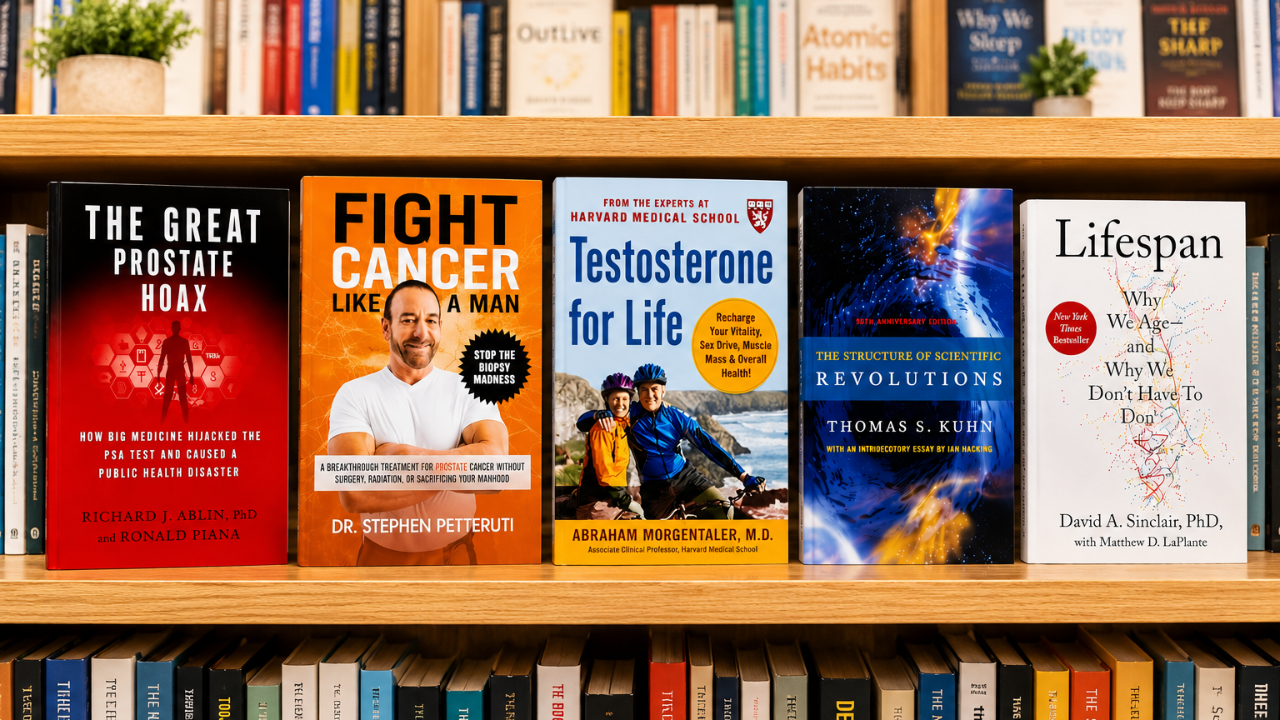
The five books below approach prostate cancer from different angles. Some challenge old ideas about PSA screening and treatment. Others explore hormone health, scientific thinking, and the biology of aging. You may not agree with every conclusion, and that’s okay. Together, these books help you decide which ideas are most relevant to your situation, ask better questions, and make decisions based on evidence instead of urgency.
Book 1: The Great Prostate Hoax
By Richard J. Ablin and Ronald Piana
Few books have had a greater impact on the debate about prostate cancer screening than The Great Prostate Hoax. Written by Dr. Richard Ablin, the scientist who discovered prostate-specific antigen (PSA), the book explains how a laboratory marker originally intended to monitor prostate cancer became one of the most widely used screening tests in medicine.
Dr. Ablin argues that PSA was never designed to diagnose prostate cancer in healthy men and describes how widespread PSA screening has contributed to unnecessary biopsies, overdiagnosis, and treatments that often leave men with lifelong urinary and sexual side effects. Whether readers agree with every conclusion or not, the book raises questions every man should understand before making decisions based solely on a PSA result.
If you've recently been told your PSA is elevated or are considering a prostate biopsy, this book can help you understand why its conclusions matter to your decision-making. It gives valuable historical context and explains why prostate cancer screening remains one of the most debated topics in men's health.
Who should read this book?
If you’ve recently had a high PSA, are considering a prostate biopsy, or want to understand why prostate cancer screening is controversial, this book offers helpful background. It is especially relevant before you make treatment decisions.
Book 2: Fight Cancer Like a Man
A Breakthrough Treatment for Prostate Cancer Without Surgery, Radiation, or Sacrificing Your Manhood
By Dr. Stephen Petteruti
Fight Cancer Like a Man was written after helping thousands of men who felt pressured to make big treatment decisions just days after hearing, "You have prostate cancer." Too often, those talks focused on getting rid of cancer with less attention to quality of life, staying healthy, and whether aggressive treatment would improve long-term results.
The book questions many old beliefs about prostate cancer. It looks at the pros and cons of PSA testing, prostate biopsy, surgery, radiation, hormone therapy, and active surveillance, and encourages men to understand the evidence before making big decisions. I also discuss metabolic health, inflammation, testosterone, nutrition, repurposed medications, and ways to help men stay healthy and live well.
This book isn’t about ignoring prostate cancer. It’s about slowing down, asking better questions, understanding the science, and making decisions based on careful risk assessment instead of fear. If you’ve been diagnosed, have a rising PSA, or want another viewpoint before choosing a treatment, this book is especially relevant.
Who should read this book?
Every man diagnosed with prostate cancer can benefit from this book. Whether you’re deciding about a biopsy, considering surgery or radiation, or looking for ways to protect your quality of life, it gives you a framework for making thoughtful, not fear-driven, decisions.
Book 3: Testosterone for Life
By Abraham Morgentaler
For years, many men have heard that testosterone and prostate cancer are closely linked. Dr. Abraham Morgentaler has spent much of his career questioning that idea through research, clinical work, and patient care. Testosterone for Life explains why hormone health deserves more attention and explores how testosterone affects energy, muscle mass, metabolism, cognition, bone health, and sexual performance.
The book also talks about a common fear for men with prostate cancer: whether testosterone replacement therapy is safe. While opinions are still changing, Dr. Morgentaler’s work has helped change the conversation and encouraged doctors to rethink old beliefs about testosterone deficiency and men’s health.
Even if you never try testosterone therapy, learning how hormones affect healthy aging gives valuable perspective to every man diagnosed with prostate cancer.
Who should read this book?
Men who are concerned about low testosterone, fatigue, muscle loss, erectile dysfunction, or how testosterone therapy relates to prostate cancer will find this book especially relevant.
Book 4: The Structure of Scientific Revolutions
By Thomas S. Kuhn
At first, this might seem like an unusual book to recommend for prostate cancer. It isn’t a medical book and doesn’t discuss PSA, biopsies, or treatments. Instead, it explains how science changes over time, which helps set up the ideas that follow.
Thomas Kuhn introduced the idea of "paradigm shifts," showing that new evidence alone often isn’t enough to change accepted medical practice. Old beliefs, institutions, and professional culture often resist change, even when better explanations appear. Eventually, the evidence becomes too strong to ignore, and a new standard takes over.
Understanding this process helps explain why debates about prostate cancer screening, biopsy, hormone therapy, and treatment still happen today. Whether or not you agree with every viewpoint, Kuhn’s work gives a useful way to think critically about medicine, instead of assuming today’s standard of care will always stay the same.
Who should read this book?
Anyone who has wondered why medical guidelines change, why doctors disagree, or why new ideas commonly face resistance before they are accepted will find this book useful.
Book 5: Lifespan
By David Sinclair
While Lifespan isn’t just about prostate cancer, it may be one of the most valuable books for men who want to improve their long-term health. Dr. David Sinclair explores the biology of aging and explains how metabolism, inflammation, mitochondrial function, cell repair, and lifestyle choices affect the development of chronic disease.
One of the book’s strengths is that it redirects focus from treating single diseases to building an internal environment that supports healthy aging. For men with prostate cancer, this view is especially important. Your prostate is not separate from the rest of your body. Body composition, insulin resistance, heart health, sleep, exercise, and nutrition all affect your overall health and resilience.
Whether or not you agree with every recommendation, Lifespan encourages readers to think beyond simply treating disease and instead focus on preserving health for decades to come.
Who should read this book?
Men who want to look beyond prostate cancer and build habits that support healthy aging, better metabolism, and a longer, healthier life will find this book relevant.
Additional Resources for Prostate Cancer Patients
Books are a great way to start learning, but they shouldn’t be your only source of information. Keep learning through podcasts, educational videos, published research, and talking with doctors who are willing to explain the evidence, discuss different viewpoints, and answer your questions.
Just as important, surround yourself with people who support thoughtful decision-making. Whether it's your spouse, family, a men's support group, or a trusted physician, having people who understand your situation can make a tremendous difference during a prostate cancer diagnosis.
Most importantly, look for healthcare providers who consider more than just your prostate. PSA trends, MRI results, metabolic health, hormone balance, heart risk, inflammation, body composition, and your overall quality of life all play a part when making informed treatment decisions.
Knowledge Is Your Greatest Advantage
A prostate cancer diagnosis doesn’t have to mean making rushed decisions. In most cases, you have time to learn, gather information, ask questions, and understand your options before choosing a treatment you can’t undo.
The five books in this guide were chosen because each gives a different perspective on prostate cancer, men’s health, scientific thinking, hormone health, or healthy aging. Together, they present a broader way to understand not just prostate cancer, but also the factors that affect long-term health and quality of life.
The more you understand your diagnosis, the more confident you’ll feel when talking with your healthcare team. Asking better questions often leads to better decisions.
Continue Your Education
If you want a different perspective on prostate cancer, high PSA, hormone health, and longevity medicine, keep learning through the resources at Intellectual Medicine.
Dr. Stephen Petteruti shares articles, podcasts, videos, and his book, Fight Cancer Like a Man, to help men better understand prostate cancer, explore treatment options, and make informed choices that support both the length and quality of life.
Whether you’re newly diagnosed, thinking about active surveillance, or just trying to understand your options, learning more is one of the best investments you can make in your health.
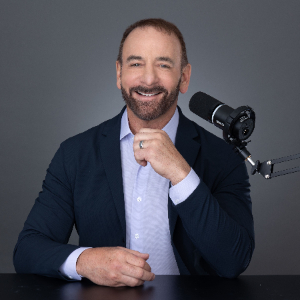
About Dr. Stephen Petteruti
Dr. Stephen Petteruti is a board-certified physician who specializes in prostate health, hormone optimization, longevity medicine, and functional medicine. With over 30 years of experience, he has helped thousands of men manage elevated PSA, prostate cancer, testosterone therapy, and healthy aging. His approach focuses on research-based decision-making, metabolic health, and the preservation of strength, vitality, and quality of life.
Learn more at https://www.drstephenpetteruti.com/
Ready to take the next step? Schedule your one-on-one consultation with Dr. Stephen Petteruti
Get exclusive insights every month
We hate SPAM. We will never sell your information, for any reason.
Author